
How the Jelly Blox Stash N Stack 2-in-1 Storage Case Actually Works
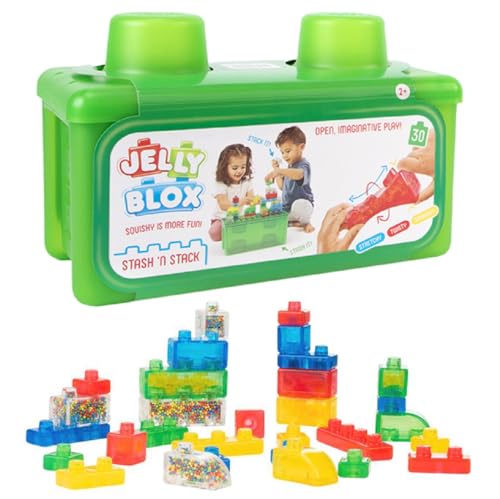
The Stash N Stack isn’t just another building block storage case — it’s a dual-mode system that switches between a flat play mat and a lockable carry case in seconds. Parents buying it often assume it works like a standard bin with a lid, then get home and wonder why there’s a grid of clips on the underside.
We built it this way on purpose. The same surface your child builds on becomes the structure that holds everything secure when folded. Understanding how those clips engage, how the hinges rotate, and where weight distributes during a carry makes the difference between a case that works flawlessly and one that spills blocks every time you pick it up.

The Clip Grid: Why It’s Not Just Decoration
Flip the mat over and you’ll see a grid of small plastic clips molded into the underside — sixteen total on the standard size, twenty-four on the large. Each clip is positioned to catch the edge of a block when the mat folds.
Those clips don’t snap onto blocks the way a traditional storage bin’s walls do. Instead, they create friction points that sandwich blocks between the folded halves of the mat. When you fold the mat in half and engage the perimeter latches, the clips press against blocks from below while the top half presses from above.
The system only works if blocks sit flat against the mat during play. Stacked towers or structures that extend more than three blocks high will prevent the mat from folding cleanly. We designed the Jelly Blox Stash N Stack: 2-in-1 Storage Case for Building Block Organization with a three-block maximum fold height — anything taller needs to be disassembled before closing.
How the Hinge Mechanism Handles Weight
The center hinge isn’t a simple fold line. It’s a reinforced nylon strap sewn into the mat with box-stitch corners, the same construction used in backpack straps rated for thirty pounds.
When you fold the mat, that hinge becomes the carry point. All the weight of the blocks transfers to the hinge instead of the perimeter latches. The latches only hold the case closed — they don’t support the load.
This is why overloading the case causes the hinge to stretch rather than the latches to pop. A stretched hinge creates a gap at the fold line, and blocks slip through. The standard mat holds up to five pounds of blocks comfortably; the large mat holds eight. Exceeding that doesn’t break the latches — it permanently deforms the hinge strap.
Loading Order: Why Bottom Layer Matters
Most parents dump all the blocks onto the mat at once, let their child build, then try to fold it. That approach ignores how the clips work.
Start by placing larger blocks around the perimeter of the mat, especially near the corners. Those blocks anchor the mat and give the clips something solid to press against when folded. Small single-stud blocks in the corners slip past the clips entirely.
The center section can hold smaller or irregularly shaped blocks, but the outer two inches of the mat should always have continuous coverage. Think of it as creating a frame — the clips grip the frame, and the frame holds everything inside.
Folding Sequence
Once blocks are placed, fold the mat in half slowly while watching the center hinge. If blocks shift or slide, stop and reposition them before continuing. The fold should feel smooth, with no resistance from blocks catching on the hinge.
Engage the side latches first, starting with the one closest to the hinge. Then move to the far latch. If you latch the far side first, the near side gap can allow blocks to shift mid-close.
What to Do When the Lid Won’t Latch
A case that won’t close completely usually has blocks positioned too close to the latch zones. Each latch needs a quarter-inch clearance to engage — a block sitting directly under the latch point prevents the teeth from meshing.
Open the case fully and check the four corners where the latches sit. Remove any blocks within a half-inch of those spots, then try folding again. If the latch still won’t catch, the hinge may be stretched from previous overloading.
A stretched hinge creates uneven pressure across the latches — one side closes fine while the other won’t seat. If this happens, our Jelly Blox Storage Case Lid Won’t Close? Here’s the Real Fix guide walks through the hinge-tension adjustment process, which takes about five minutes with a hairdryer and a flat surface.

Carrying vs Storing: Two Different Positions
The Stash N Stack has a carry handle on one short end and a flat base on the other. Most people grab the handle and carry it like a briefcase, which works fine for short distances.
For longer carries — walking to a friend’s house or taking it in the car — flip the case so the handle side faces up and the base rests against your hip. This distributes weight along your forearm instead of pulling straight down on your wrist.
When storing the case on a shelf, always place it handle-side down with the base facing out. Storing it handle-up puts all the weight on the latches, which aren’t designed to bear load in that orientation. Over weeks or months, this can cause the latch teeth to deform and lose their grip.
The 2-in-1 Storage Case – Portable Organizer Solution includes a set of rubber feet on the base specifically to create airflow when stored upright — storing it upside-down blocks that ventilation and can trap moisture if the blocks were wet from washing.
Why the Dual-Mode Design Works
The Stash N Stack asks parents to think differently about block storage. Instead of separating play space from storage container, it combines both into one object that changes shape based on what you need right now.
That design only delivers value if you use it the way the hinge, clips, and latches were engineered to work together. Load the perimeter first, respect the fold-height limit, and latch near-to-far — those three rules account for 90% of the “it won’t close” or “blocks fell out” complaints we hear.
Once you internalize the logic, the case becomes faster to pack than a traditional bin. No scooping, no dumping — just fold and latch. The system works because the play surface is the storage surface, and understanding that single principle makes everything else obvious.
Common Questions About Stash N Stack Operation
Yes, but only by hand with a damp cloth. The mat is water-resistant nylon, but submerging it or running it through a washing machine will damage the hinge stitching and warp the clip grid.
Wipe the surface with a cloth dampened in warm water and mild dish soap, then air-dry it completely before folding. Never fold a damp mat — moisture trapped between the halves can mildew and stain the fabric.
Small single-stud blocks or flat tiles slip past the clip grid because they’re thinner than the clip depth. The clips are sized for standard two-stud-height blocks.
If you’re storing a lot of small pieces, place them in the center of the mat and surround them with taller blocks. The taller blocks create a wall that traps the smaller ones when folded.
The standard mat holds approximately 200 two-by-four standard blocks when loaded in a single layer with minimal stacking. The large mat holds around 350.
Those numbers assume blocks are placed flat. If you build upward with towers or structures, capacity drops because the fold height limit kicks in sooner.
Absolutely. The mat works perfectly as a standalone play surface. The clip grid on the underside doesn’t interfere with building — in fact, it adds a slight texture that helps blocks grip better on smooth floors.
Some parents keep one mat dedicated for travel and another always flat at home. The fold mechanism doesn’t wear out from non-use, so leaving it flat indefinitely won’t damage anything.
The regular storage case is a rigid bin with a hinged lid and no play-mat function. It’s designed for permanent shelf storage and holds more blocks — around 400 standard pieces — but doesn’t convert for travel.
The Stash N Stack sacrifices some capacity for portability. If you never need to take blocks on the go, the regular case is more efficient. If you travel frequently or want a surface your child can build on at grandma’s house, the Stash N Stack makes more sense.
The latches are rated for 500 open-close cycles under proper loading conditions. What breaks them prematurely is forcing the case closed when blocks are positioned wrong or attempting to latch it while the hinge is under tension from overloading.
If a latch cracks, replacement latch sets are available and install with a small Phillips screwdriver. Each latch has two screws through the mat fabric — no sewing or adhesive required.